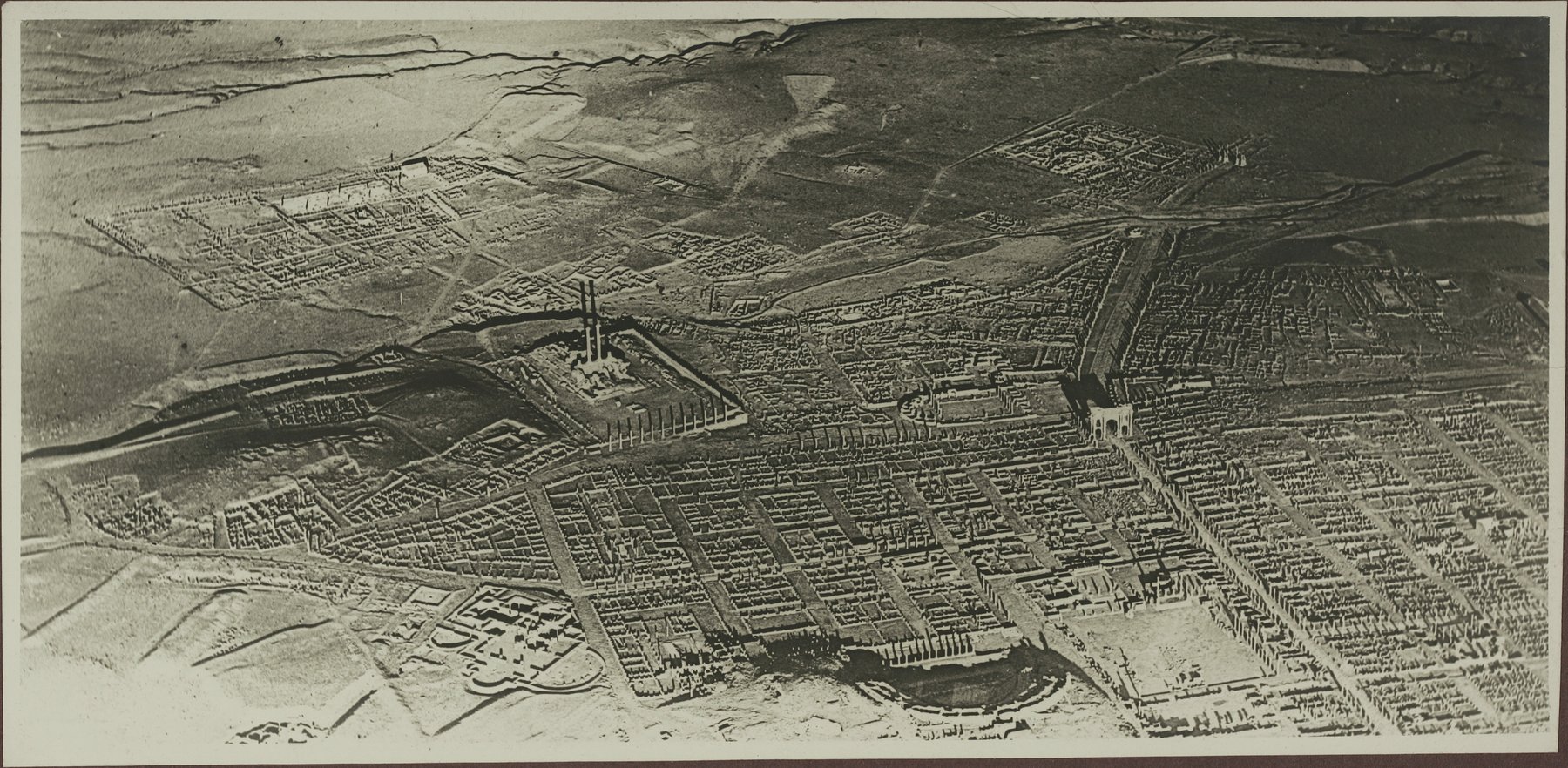
Timgad has been excavated for nearly 150 years, across three rather different political landscapes. This timeline lays out the scholarly record in a single view: the directors who ran each campaign, the publications that shaped how the city has been read, and the house-by-house discoveries that built the domestic corpus. Hover or tap any event for detail.
The timeline is continuously updated as new scholarship is read and catalogued. Omissions and corrections are inevitable on a record this long, and readers who spot one are warmly invited to be in touch.
Select an event above to read its description, the houses or buildings it uncovered, and the source citation. Or scroll down for the full chronological list.
Full chronology
Scholarly reliance chain
Later work builds on earlier work, but not uniformly. The most reliable early plans come from Ballu's 1897 and 1911 monographs. The Boeswillwald, Cagnat, and Ballu 1905 synthesis pulled this material together for a wider audience. Christofle's 1927 to 1936 reports added new excavations rather than reproducing Ballu's. Courtois's 1951 synthesis is frequently cited but its plans are often schematic or conjectural, and Rebuffat (1969, p. 676) warned specifically against treating them as precise. Germain's 1969 mosaic corpus and Rebuffat's 1969 peristyle catalog standardized the comparative record. Modern digital work by Wilson, Dufton, Rezkallah, and Yelles now reads the colonial-era archive against itself, correcting and contextualizing it rather than taking it on faith.
Notes on reliability
Rezkallah (2020) confirms that the southeastern quarter of Timgad has no prior surveys of record. The 12 houses in Rebuffat's catalog have standardized 1:500 plans and are the most reliable comparative base. Five further houses are known from Ballu's 1911 monograph but not in Rebuffat (Maisons 25, 27, 38, 72, 73). The largest documented house, the Maison à l'ouest des Thermes des Filadelfes at roughly 2,469 square meters, was excavated in 1921 and 1922. Andrew Wilson (2001) identified at least 22 fullonicae, twice the number attested at Pompeii, concentrated in the northeastern quarter. Amraoui (2018) has since revised that figure downward to 12 fullonicae under stricter identification criteria, of which only five can be precisely located today (Bande NW, Ilots 11, 21, 30, 32).
How to cite
Edher, Kim. 2026. “A Timeline of Excavation.” Houses of Roman Timgad. Accessed [Month Day, Year]. https://timgadhouses.org/timgad/timeline/.
All content is licensed CC BY 4.0: quote or reproduce freely with credit.