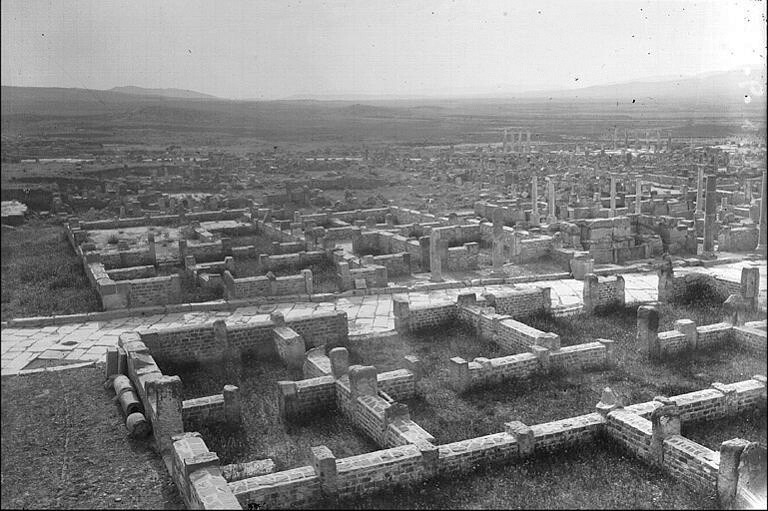
Timgad sits on a high plain in the Aurès Mountains of northeastern Algeria, in what was the Roman province of Numidia and is today the Batna province of a sovereign post-colonial state. The city is known in Arabic as تيمقاد, in Latin as Colonia Marciana Traiana Thamugadi (a name likely rooted in a Berber/Amazigh toponym), and in French-colonial and Anglophone scholarship simply as Timgad. This page is the brief overview of where Timgad is, how it was founded, and why reading its remains is more than simply a question of archaeological curiosity.
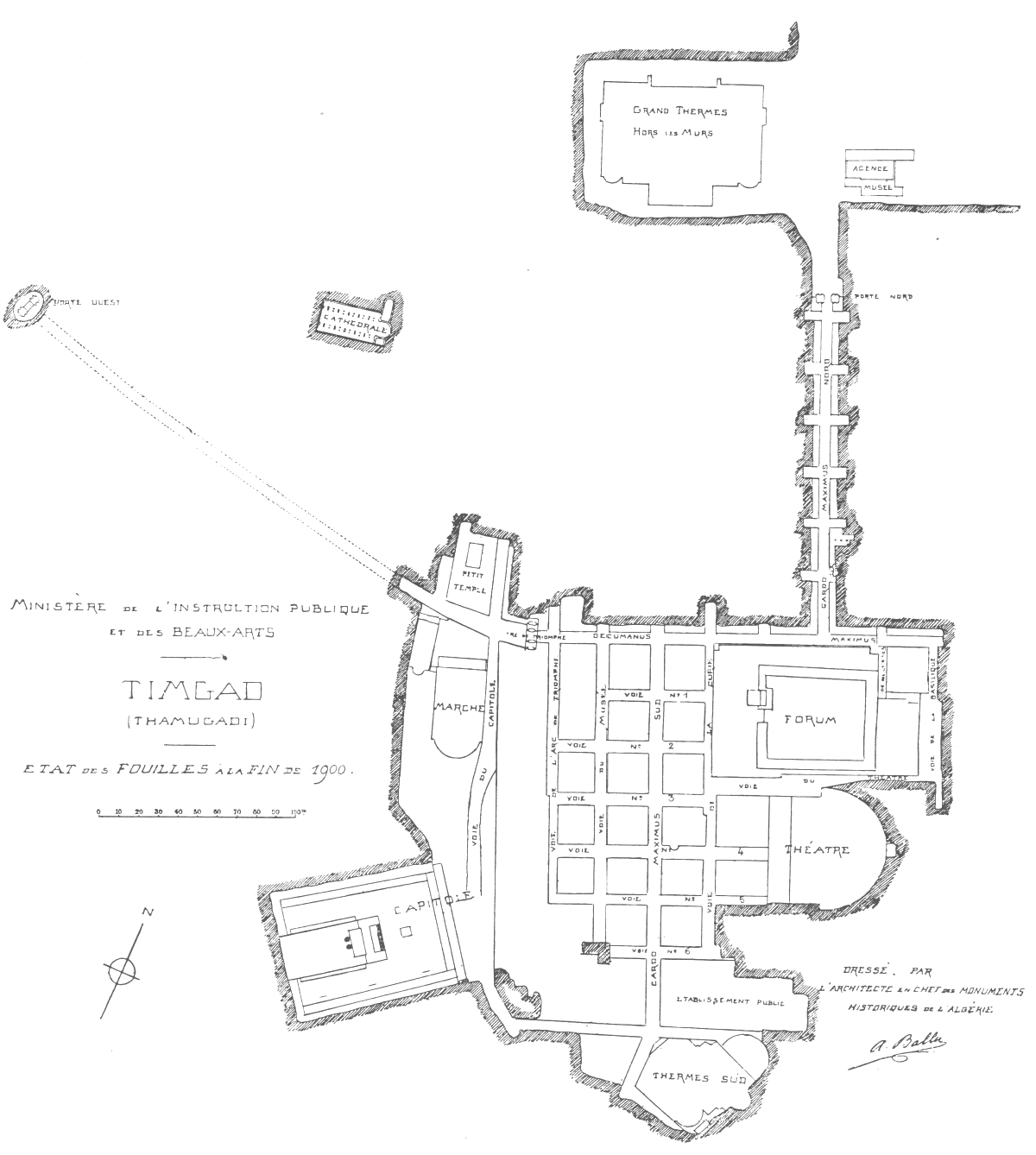
From imperial plan to lived reality
Timgad was founded in 100 CE by the emperor Trajan as a colony for military veterans of the Third Augustan Legion. The Romans had been planting such coloniae across the empire for centuries, especially at frontiers, as a way to settle retired soldiers, secure newly held territory through their continued loyalty, and project Roman urban life into provincial landscapes. Timgad sits squarely in that tradition: a planted city at the foot of the Aurès, part of Rome’s hold on Numidia.
Its full formal name, Colonia Marciana Traiana Thamugadi, is preserved on a foundation inscription discovered at the foot of one of the triumphal arches, which names Trajan as founder, the Third Augustan Legion as construction force, and Munatius Gallus as the provincial legate overseeing the project.
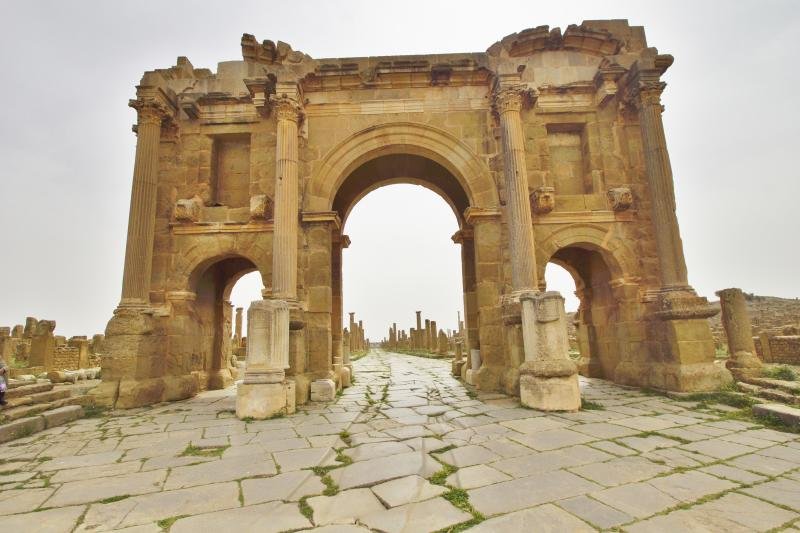

The city was laid out on a strict orthogonal grid, with two main streets meeting at right angles: the cardo maximus running north to south toward Constantine, and the decumanus maximus running east to west toward Lambèse. It has been used in textbooks ever since as an exemplar of Roman colonial urban planning.
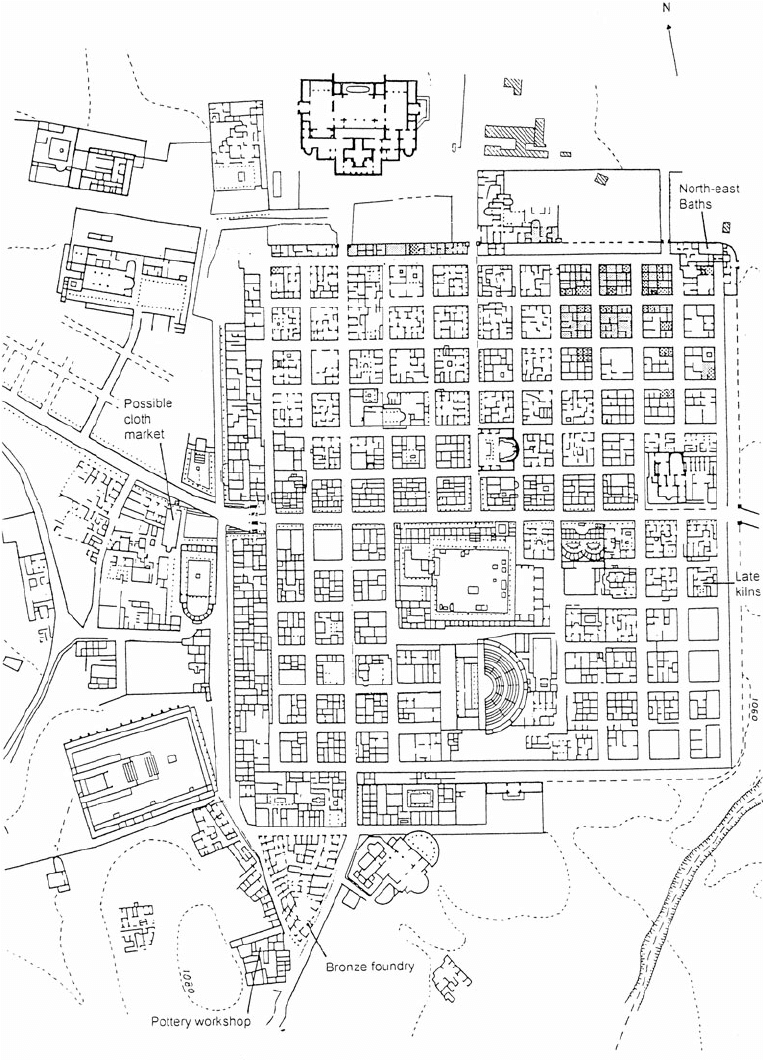
What is most useful about Timgad for this project is not the symmetry of the founding moment but how quickly that moment was outgrown. By the middle of the second century CE, the rapid growth of the city had already ripped through its own foundational confines. The lived reality of its inhabitants exceeded the imperial vision of orderly colonial space almost immediately, and the city went on being inhabited and rebuilt for the next five centuries, until the Maures drove out the inhabitants and, according to Procopius, destroyed it in late antiquity to prevent Byzantine reoccupation.
That sudden abandonment is why Timgad reads so clearly today. Buried by sand for centuries, the site preserves one of the best snapshots anywhere of Roman colonial urbanism and of the domestic life that unfolded inside it. Some scholars still nickname it “the Pompeii of North Africa,” and UNESCO has held it on its World Heritage list since 1982.
A second layer of colonial history
Timgad’s colonial experiences extend far beyond antiquity. When French forces occupied Algeria in 1830, they used the Latin inscriptions scattered through Timgad’s gridded streets as a precedent for their own colonial agenda. Louis Renier, one of the first generation of French epigraphists in Algeria, was approached by a local sheikh while copying a Latin text and asked if he could read what he was copying. Renier, bragging of being a direct descendant of the Romans, responded:
Oui, je la comprends et je l’écris: car c’est la miene aussi. Regards ce sont nos lettres, c’est notre langue.
Yes, I understand it and I can write it, because it is my language also. Look, these are our letters, this is our language.
Over 60,000 Latin texts have been recorded across the Maghreb. Renier alone reported some four thousand from a single expedition in the mid-1850s. The site’s physical form, as a colony for military veterans, further appealed to French officers who could imagine themselves as rightful heirs of Rome in Algeria.
This was never just about archaeology. The misappropriation of Rome by colonial-era archaeologists was used to justify the French occupation of modern Algeria. Latin inscriptions became evidence for a continuity that France’s officials wanted to claim. Algerian scholars were gatekept out of the work being done on their own land, and the people whose ancestors had built and lived in Timgad before, during, and after Rome were quietly disinherited from their own history. Two centuries of how Timgad has been excavated, catalogued, and written about still carry the weight of those choices.
Since Algeria won its independence in 1962, after a decolonial war whose human cost fell overwhelmingly on Algerians, Timgad has belonged again to the country whose land it has always sat on. Its position is no longer ambiguous so much as it is layered. It is an Algerian heritage site, a place of tourism for Algerian and international visitors, and it carries the residue of two empires written into its stones. This colonial scar cannot go unacknowledged as it makes Timgad simultaneously an ancient archaeological site and a contemporary space where questions of identity, belonging, and historical memory remain open, questions whose centre of gravity has rightly returned to the people of the Maghreb.
A note on terminology
This site uses the phrase “Roman North Africa” where it is conventional, but with awareness of what that phrase does. The term privileges the Roman period over the region’s longer indigenous and Punic histories. When we talk about “Roman houses” in “Roman Africa” we risk obscuring the Libyan farmers who built them, the Punic architectural traditions they incorporated, and the discrepant identities of the people who actually lived inside their walls. Those inhabitants may have understood themselves as Numidian, African, Punic, Libyphoenician, or various combinations thereof. Their relationship to “Romanness” was a spectrum of grey, contested, strategic at times, rarely absolute.
A spectrum, not a binary.
The phrase is kept in use here for searchability and cross-disciplinary clarity. The point of this section is that you should treat it as imperfect shorthand, not as a description of who the people inside these houses actually were.
A timeline of excavation
The scholarly record of Timgad runs from the first reconnaissance in 1880 through the most recent digital work of the 2020s, across three very different political eras. The Timeline of Excavation lays that record out in a single interactive view: the directors who ran each campaign, the landmark publications, and the house-by-house discoveries that built the domestic corpus the dissertation is reading.
What to read next
For the argument the project is built around and the person running it, start with the About page. For the domestic corpus that is the main subject of this work, see Houses. For the analytical tools that ground the reading, see Methods. For the full bibliography organized by theme, including the colonial-era excavation reports that sit behind everything on this page, see Scholarship.
How to cite
Edher, Kim. 2026. “Timgad.” Houses of Roman Timgad. Accessed [Month Day, Year]. https://timgadhouses.org/timgad/.
All content is licensed CC BY 4.0: quote or reproduce freely with credit.